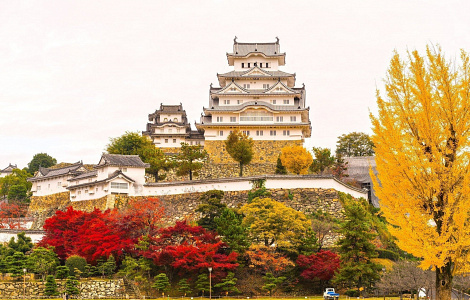
You will meet your guide for a day trip to see Himeji-jo, which is considered the finest surviving example of Japanese classical castle architecture. Residents respectfully call it Hime-Sama, or Madam Princess. A castle-fortress is usually associated with men, but not this one. For its dazzling white color and multi-tiered roofs, reminiscent of the wings of a huge bird, the fortress is also called the Castle of the White Heron.
The history of the fortress dates back to 1346, but it acquired its current architectural splendor in 1609, when the ruler of the local lands, Prince Ikeda Terumasa, married a beautiful princess, Great Shogun Tokugawa’s eldest daughter.
.
You will have an opportunity to see the interiors of the largest surviving watchtower in Japan. The gigantic structure, designed to protect the city, is surprisingly harmonious and elegant.
In spring, sakura flowers dominate the landscape. There is so much white Yoshino with large petals that the sky and earth are almost invisible. The cascades of pink flowers on the Weeping Sakura and whole streams of Sakura-Waterfall branches fall into the smooth mirrors of the ponds. In the evening, when the torches are burning, the castle and the gardens are illuminated, forming a truly mystical sight!
You will see the place of the sacred ceremony of seppuku, the Kiku well. One can still hear a gentle voice in the night. At all times, Himeji-jo has been protecting the city, and the city repaid her handsomely. You will learn an amazing story about the rescue of the Princess. In December 1993, Himeji-jo was listed as a UNESCO World Heritage Site. After the excursion is finished, you will come back to your hotel in Osaka.
There’s a hidden world beneath Tokyo — not a subway or an ancient tunnel, but something out of a sci-fi epic. Fifty meters below the quiet streets of Saitama lies the Metropolitan Area Outer Underground Discharge Channel, known to locals as Shutoken Gaikaku Hosuiro. Built to protect Tokyo from floods, this colossal underground space has become one of Japan’s most intriguing offbeat attractions.


 Top
Top